Circuit Breaker Pattern: How to Prevent One Failed Service from Bringing Down the Ent...
HomepageArticlesCircuit Breaker Pattern: How to Prevent One Fa...
Circuit Breaker Pattern: How to Prevent One Failed Service from Bringing Down the Entire System???
Introduction
Modern applications often rely heavily on interconnected services. When one service becomes slow or unavailable, it can negatively impact many other services that depend on it. To address this challenge, engineers use the Circuit Breaker Pattern, one of the most important resilience patterns in distributed systems.
What is the Circuit Breaker Pattern?
The Circuit Breaker Pattern is a mechanism that prevents an application from continuously sending requests to a failing or unresponsive service.
Instead of waiting for timeouts on every request, the circuit breaker temporarily stops requests and gives the affected service time to recover.
Why Is It Important?
Without a Circuit Breaker:
Failed requests continue to accumulate
Response times increase
Resource consumption grows
Problems spread across the system
With a Circuit Breaker:
Failures are contained
Resources are protected
Overall system stability improves
How Does It Work?
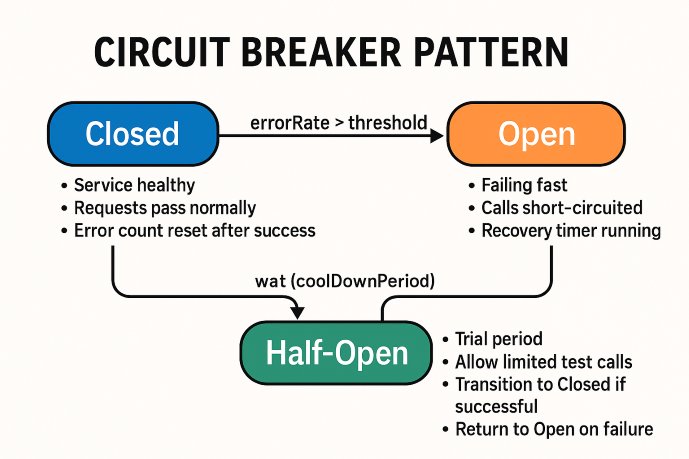
A Circuit Breaker typically operates in three states:
Closed State
All requests are allowed to pass normally because the service is functioning correctly.
Open State
The circuit detects excessive failures and temporarily blocks requests from reaching the service.
Half-Open State
A limited number of requests are allowed through to test whether the service has recovered.
If the test requests succeed, the circuit returns to the Closed state. If failures continue, it returns to the Open state.
Practical Example
Imagine that a payment service becomes unavailable.
Without a Circuit Breaker
Applications continue sending payment requests.
Timeouts accumulate.
Resources become exhausted.
Other services may also experience degradation.
With a Circuit Breaker
Requests to the payment service are temporarily stopped.
The rest of the system continues operating normally.
The payment service is periodically tested for recovery.
Benefits of the Circuit Breaker Pattern
Improved Reliability
Prevents failures from cascading throughout the system.
Reduced Resource Consumption
Avoids wasting CPU, memory, and network resources on requests that are likely to fail.
Better User Experience
Users receive immediate and meaningful error messages instead of waiting for long timeouts.
Faster Recovery
Allows failing services time to recover without being overwhelmed by continuous traffic.
Popular Circuit Breaker Tools
Resilience4j
Hystrix
Istio
Envoy
Common Use Cases
Microservices architectures
Cloud-native applications
API integrations
External service dependencies
Distributed systems
FAQ
Is the Circuit Breaker Pattern used only in Microservices?
No. While it is most commonly associated with Microservices, it can be applied to any system that depends on external services or remote resources.
Does it solve all failure-related problems?
No. However, it significantly reduces the impact of service failures and helps prevent cascading outages.
Conclusion
The Circuit Breaker Pattern is one of the most effective techniques for building resilient systems. By preventing repeated calls to failing services, it helps contain problems, protect resources, and ensure that localized failures do not escalate into system-wide outages. As distributed architectures continue to grow in complexity, Circuit Breakers remain a fundamental component of reliable and fault-tolerant applications.
 2019 - 2023 © WELNIZ.LTD. All rights reserved.

 United Arab Emirates (Arabic)
 Worldwide (English)