Cloud Bursting: How to Handle Traffic Spikes Without Buying Additional Servers?
HomepageArticlesCloud Bursting: How to Handle Traffic Spikes W...
Cloud Bursting: How to Handle Traffic Spikes Without Buying Additional Servers?
Introduction
Many websites and applications experience periods of heavy demand due to seasonal promotions, marketing campaigns, product launches, or unexpected events. Purchasing enough servers to handle peak traffic year-round can be expensive and inefficient.
This is where Cloud Bursting comes in—a smart approach that combines on-premises infrastructure with public cloud resources to handle sudden workload increases.
What is Cloud Bursting?
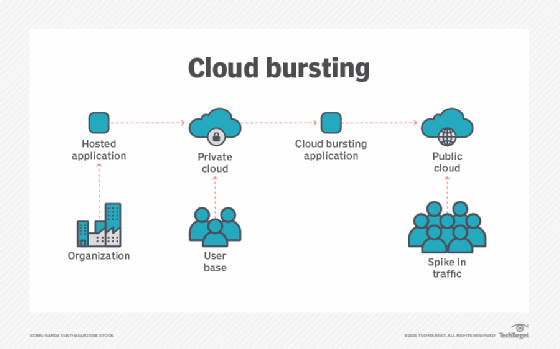
Cloud Bursting is a deployment model where applications run on their primary infrastructure under normal conditions, and when demand exceeds available capacity, additional workloads are automatically redirected to cloud resources.
In simple terms, cloud resources are used only when they are needed.
How Does Cloud Bursting Work?
During Normal Operations
Applications run on the primary infrastructure.
Only local or dedicated resources are utilized.
Cloud resources remain inactive.
During Traffic Surges
Additional cloud resources are automatically provisioned.
A portion of incoming requests is redirected to the cloud.
The system scales beyond its normal capacity.
After the Traffic Spike Ends
Cloud resources are released.
The application returns to its standard operating environment.
Practical Example
Imagine an e-commerce platform that receives:
5,000 visitors per day under normal conditions.
100,000 visitors during annual sales events.
Instead of maintaining expensive infrastructure capable of handling peak traffic all year long, the company can use Cloud Bursting to expand capacity only during major sales periods.
Benefits of Cloud Bursting
Cost Reduction
Pay only for additional resources when demand increases.
High Flexibility
Handle unexpected traffic spikes without permanent infrastructure investments.
Improved User Experience
Reduce the risk of slowdowns, outages, or service interruptions during peak periods.
Better Resource Utilization
Avoid running underutilized servers throughout the year.
Challenges
Deployment Complexity
Requires careful planning and integration between environments.
Data Synchronization
Data may need to be continuously synchronized between local infrastructure and cloud resources.
Security Considerations
Communication between environments must be properly secured and monitored.
When Is Cloud Bursting Most Useful?
E-commerce platforms
Online booking systems
Event registration websites
Live streaming services
Educational platforms during exam periods
Applications with seasonal or unpredictable demand
Cloud Bursting vs. Auto Scaling
Auto Scaling
Increases resources within the same environment or cloud platform.
Cloud Bursting
Extends workloads to a separate cloud environment when existing infrastructure reaches its limits.
FAQ
Is Cloud Bursting suitable for every project?
No. It is most beneficial for applications that experience periodic or unpredictable traffic spikes.
Can Cloud Bursting be used with Kubernetes?
Yes. Modern Kubernetes solutions support hybrid and multi-cloud architectures that enable Cloud Bursting scenarios efficiently.
Does it really reduce costs?
In many cases, yes. Organizations avoid purchasing and maintaining infrastructure that would remain underutilized for most of the year.
Conclusion
Cloud Bursting provides a practical and cost-effective way to handle sudden increases in demand without permanently investing in oversized infrastructure. By combining on-premises resources with on-demand cloud capacity, organizations can achieve a balance between performance, scalability, and operational costs.
 2019 - 2023 © WELNIZ.LTD. All rights reserved.

 United Arab Emirates (Arabic)
 Worldwide (English)