For many years, organizations relied on a simple security principle: if a user was inside the corporate network, they were considered trustworthy. However, with the rise of remote work, cloud computing, and increasingly sophisticated cyberattacks, this approach is no longer effective.
As a result, Zero Trust Architecture (ZTA) emerged, based on a simple but powerful principle:
"Never trust, always verify."
Zero Trust Architecture is a security model that assumes any user, device, or application could be untrusted until continuously verified.
Whether a user is inside or outside the network, their identity and permissions must be validated before access to resources is granted.
In the past, most systems operated within isolated, on-premises data centers.
Today, the landscape has changed dramatically due to:
As a result, relying solely on network boundaries is no longer sufficient.
Every access request must be authenticated and authorized.
Users receive only the minimum permissions necessary to perform their tasks.
The network is treated as if an attacker may already be present.
All activities are logged, monitored, and analyzed in real time.
When a user attempts to access a service or resource:
Even if one account is compromised, attackers face additional barriers to movement within the environment.
Unauthorized access to sensitive resources is significantly reduced.
Employees can securely access resources from virtually anywhere.
Helps organizations meet modern security and regulatory requirements.
Adds an extra layer of identity verification.
Controls user permissions and access policies.
Divides networks into smaller, isolated segments to limit lateral movement.
Requires careful planning and phased deployment.
Some older systems may not easily support Zero Trust principles.
Managing policies and access controls can become more demanding, especially in large organizations.
Yes. Small organizations can start with practical steps such as:
No. Firewalls remain important and work alongside Zero Trust as an additional layer of security.
Yes. In fact, it is considered one of the best security practices for cloud infrastructures.
Absolutely. It is widely used to secure modern cloud-native environments and distributed applications.
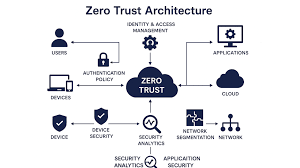
Zero Trust Architecture has become one of the most important modern cybersecurity models because it treats every access request as untrusted until verified. As organizations continue to embrace cloud services and remote work, Zero Trust is expected to become a fundamental standard for protecting digital environments.
 2019 - 2023 © WELNIZ.LTD. All rights reserved.

 United Arab Emirates (Arabic)
 Worldwide (English)