You might assume that once a server, database, or service recovers from a temporary outage, the problem is over. However, in many cases, a new and potentially more dangerous issue emerges immediately after recovery: the Thundering Herd Problem.
This phenomenon occurs when a large number of processes, clients, or users simultaneously attempt to access the same resource the moment it becomes available again.
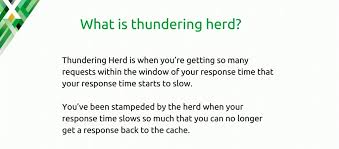
The Thundering Herd Problem is a situation where a massive number of waiting requests are released at the same time, overwhelming a service or resource immediately after it recovers from downtime or a waiting state.
Imagine the following scenario:
Instead of recovery, the system experiences another outage.
The Thundering Herd Problem commonly appears in:
Any shared resource that receives a large number of simultaneous requests can be affected.
The volume of requests may exceed the system's capacity within seconds.
CPU, memory, network bandwidth, or connection pools can quickly reach their limits.
A service may crash again immediately after being restored.
Users may experience delays, timeouts, or recurring service interruptions.
Implement exponential backoff strategies so clients retry gradually instead of all at once.
Control the number of requests allowed within a specific time period.
Process requests in a controlled and orderly manner rather than releasing them simultaneously.
Reduce dependence on the primary resource by serving frequently requested data from cache.
Introducing random delays between retries helps prevent synchronized request storms.
The Thundering Herd Problem is frequently seen in:
No. It can also occur when:
A load balancer can help distribute traffic across multiple instances, reducing the impact. However, it does not eliminate the root cause of synchronized request bursts.
The Thundering Herd Problem is a common challenge in large-scale systems that can cause services to fail again immediately after recovery. By implementing strategies such as exponential backoff, rate limiting, caching, and request queuing, organizations can prevent sudden traffic surges and ensure smoother system recovery.
 2019 - 2023 © WELNIZ.LTD. All rights reserved.

 United Arab Emirates (Arabic)
 Worldwide (English)