Modern systems rely on multiple servers working together to ensure high availability and service continuity. However, under certain conditions, a communication failure between these servers can lead to a critical issue known as the Split-Brain Problem.
This is considered one of the most challenging problems in distributed systems because it can result in data conflicts, inconsistencies, and difficult recovery processes.
The Split-Brain Problem occurs when a cluster of servers or nodes becomes divided into two or more groups due to a network partition or communication failure.
Each group believes it is the legitimate primary cluster and continues operating independently.
As a result, multiple nodes may begin making decisions and processing requests simultaneously without coordination.
Imagine a database cluster consisting of two servers:
If communication between them is interrupted:
Both servers begin accepting write operations independently.
This can quickly lead to conflicting versions of the same data.
The same record may be modified differently on separate nodes.
Data across the cluster becomes inconsistent and unreliable.
Merging divergent datasets after connectivity is restored can be extremely complex.
Applications may receive different responses depending on which node they communicate with.
The Split-Brain Problem can affect many distributed environments, including:
Any system that relies on coordinated communication between nodes is potentially vulnerable.
Require approval from a majority of nodes before critical operations or leadership decisions can occur.
This prevents isolated minority groups from acting independently.
Introduce a third node that acts as a tiebreaker when communication issues arise.
Force isolated or suspected nodes to stop processing requests, preventing them from making unauthorized changes.
Detect connectivity issues quickly and trigger automated recovery procedures.
Use reliable consensus algorithms to ensure that only one node can act as the leader at any given time.
Preventing it with absolute certainty is difficult in distributed systems. However, proper architecture and consensus mechanisms can significantly reduce the likelihood of occurrence.
Yes. Kubernetes clusters can experience Split-Brain-related issues, particularly in multi-node environments if quorum requirements are not maintained.
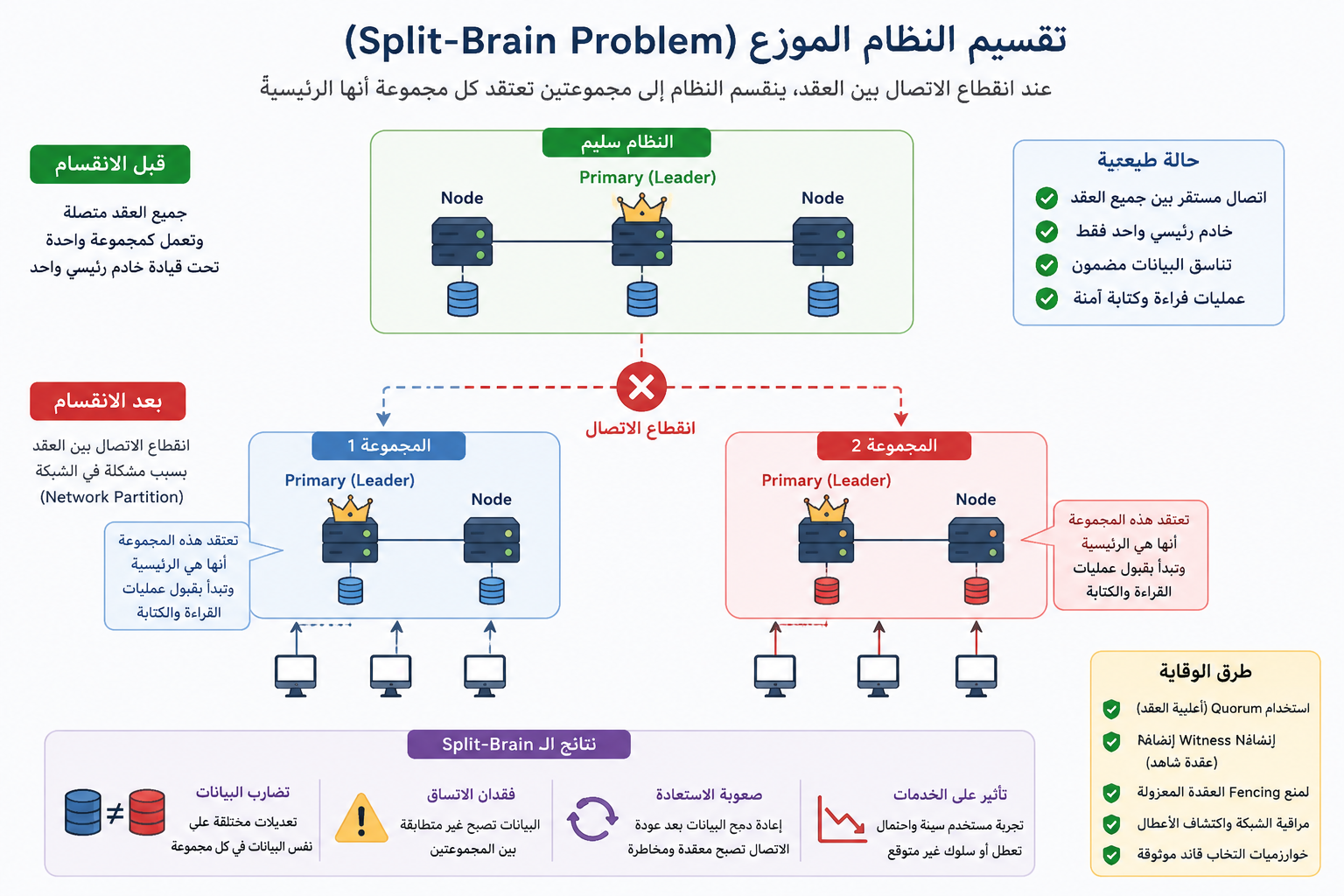
The Split-Brain Problem is one of the most serious challenges in distributed computing. When multiple nodes mistakenly believe they are the primary authority, data conflicts and consistency issues can quickly emerge. By implementing quorum-based architectures, witness nodes, fencing mechanisms, and robust network monitoring, organizations can greatly reduce the risk and maintain reliable, consistent distributed systems.
 2019 - 2023 © WELNIZ.LTD. All rights reserved.

 United Arab Emirates (Arabic)
 Worldwide (English)