Load Balancer: How Do Large Websites Handle Millions of Visitors???
HomepageArticlesLoad Balancer: How Do Large Websites Handle Mi...
Load Balancer: How Do Large Websites Handle Millions of Visitors???
Introduction
Large websites and applications sometimes receive millions of requests every day. If all these requests were sent to a single server, it could easily become overloaded or even crash. This is where a Load Balancer becomes essential for improving performance and stability.
What is a Load Balancer?
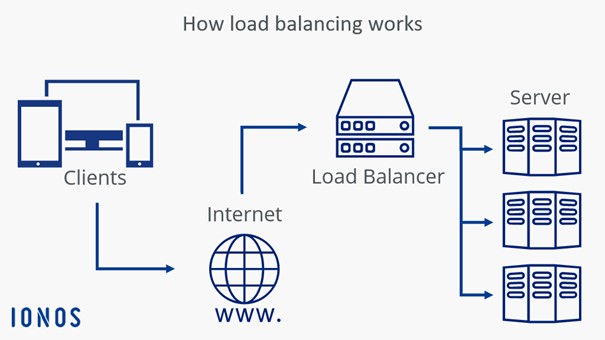
A Load Balancer is a system or service that distributes incoming user requests across multiple servers instead of relying on just one server.
How Does It Work?
When a user visits a website:
The request first reaches the Load Balancer
The Load Balancer checks the status of available servers
It forwards the request to the least busy or most suitable server
The response is returned to the user quickly and reliably
Why Is It Important?
Performance Improvement
Traffic is distributed across multiple servers to reduce overload.
High Availability
If one server fails, requests are automatically redirected to another server.
Easy Scalability
New servers can be added without shutting down the service.
Better User Experience
Users benefit from faster response times and greater stability.
Common Types of Load Balancing
Round Robin
Requests are distributed evenly between servers.
Least Connections
Requests are sent to the server with the fewest active connections.
IP Hash
Users are directed to the same server based on their IP address.
Where Are Load Balancers Used?
E-commerce websites
Live streaming platforms
Online gaming systems
Cloud applications
Popular Load Balancer Tools and Services
NGINX
HAProxy
AWS Elastic Load Balancer
Cloudflare Load Balancing
Challenges
Requires accurate configuration
Can become a single point of failure if not secured properly
Needs continuous monitoring and maintenance
FAQ
Is a Load Balancer necessary for every website?
No, but it is very important for websites with high traffic.
Does it improve website speed?
Yes, because it reduces the load on individual servers.
Conclusion
A Load Balancer is a critical part of modern infrastructure because it improves performance, increases stability, and allows applications to scale efficiently.
 2019 - 2023 © WELNIZ.LTD. All rights reserved.

 United Arab Emirates (Arabic)
 Worldwide (English)