Your servers may be running perfectly today, but after months of manual changes and undocumented modifications, unexpected issues can start appearing without any obvious reason. In many cases, the root cause is Infrastructure Drift.
Infrastructure Drift occurs when the actual infrastructure environment deviates from its original documented configuration or the definitions stored in Infrastructure as Code (IaC) systems.
In other words, servers and resources gradually begin operating with settings that differ from what they are supposed to have.
Common causes include:
When configurations differ from the expected state, identifying the root cause of issues becomes significantly more challenging.
Servers may no longer operate under the same configurations, leading to unpredictable behavior across environments.
Unauthorized or undocumented changes may bypass security policies and compliance requirements.
Updates may work successfully in one environment while failing in another due to configuration discrepancies.
You may be experiencing Infrastructure Drift if you notice:
Using tools such as Terraform helps compare the current infrastructure state against the desired configuration.
Periodic reviews can identify differences between the actual environment and the intended architecture.
Continuous monitoring solutions help detect unauthorized or unexpected infrastructure changes.
Organizations can minimize Infrastructure Drift by:
No. Infrastructure Drift can occur in any IT environment, including on-premises data centers, hybrid infrastructures, and cloud platforms.
Yes. Terraform is one of the most widely used tools for identifying and managing Infrastructure Drift by comparing the desired state with the actual infrastructure state.
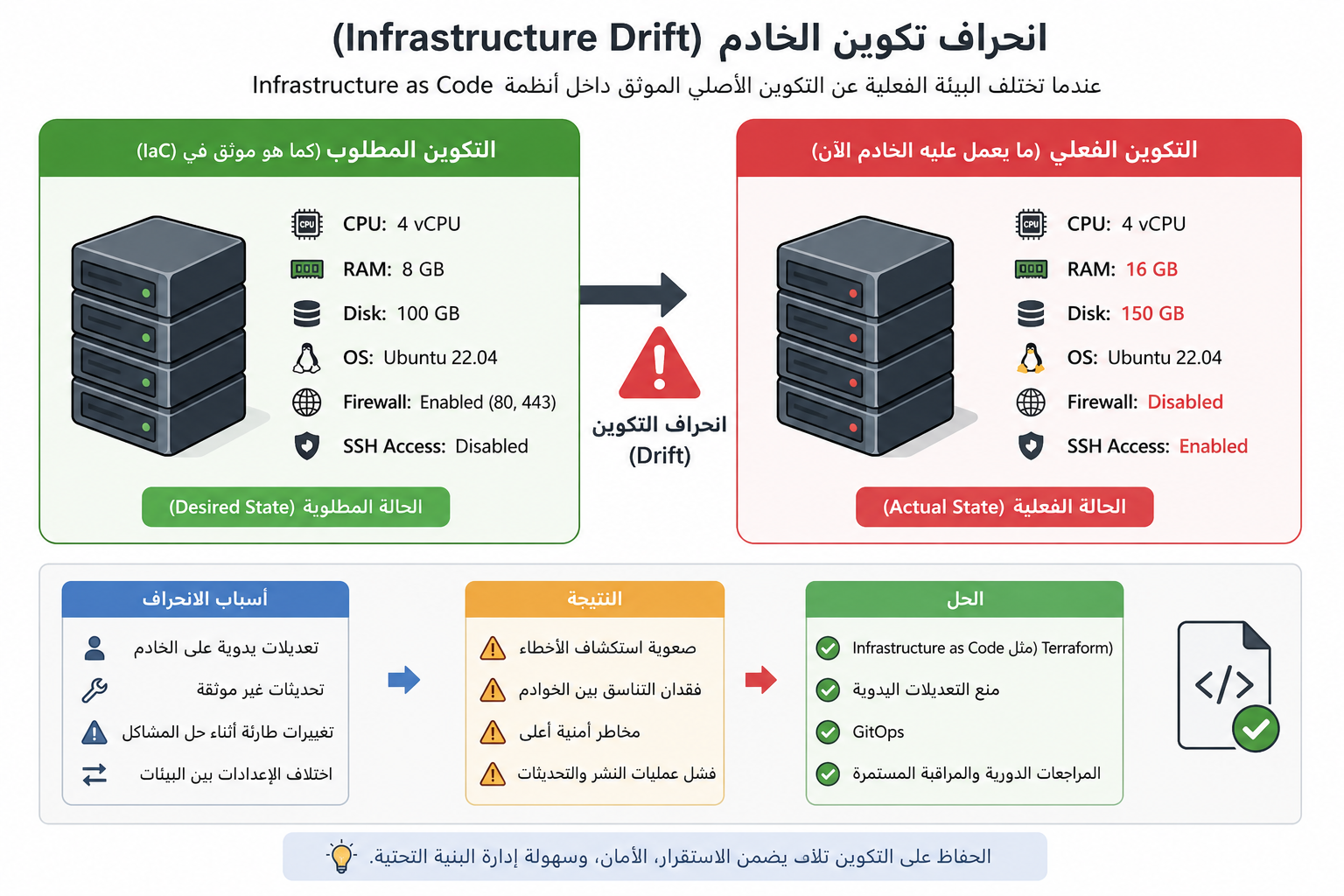
Infrastructure Drift is one of the most overlooked issues affecting the stability and reliability of modern systems. By adopting Infrastructure as Code, automation, proper documentation, and GitOps practices, organizations can maintain consistency, improve security, and reduce operational risks.
 2019 - 2023 © WELNIZ.LTD. All rights reserved.

 United Arab Emirates (Arabic)
 Worldwide (English)