As applications grow and user traffic increases, organizations need additional resources to maintain performance and reliability. At this point, system administrators and architects face an important question:
Should we make the existing server more powerful, or should we add more servers?
The answer depends on understanding the difference between Vertical Scaling and Horizontal Scaling.
Vertical Scaling (also known as Scaling Up) means increasing the resources of an existing server.
Examples include:
The application continues to run on the same server, but with more powerful hardware resources.
Usually requires fewer architectural changes compared to distributed systems.
Managing a single server is often easier than managing multiple servers.
Works well for applications that are not designed for distributed environments.
Every server has a maximum hardware limit that cannot be exceeded.
Hardware upgrades may require restarting or temporarily shutting down services.
High-end servers become increasingly expensive as resource requirements grow.
Horizontal Scaling (also known as Scaling Out) means adding more servers and distributing workloads among them.
Instead of making one server larger, multiple servers work together to handle increasing demand.
New servers can be added as demand grows.
If one server fails, other servers can continue serving requests.
Widely used in cloud-native applications, containers, and microservices environments.
Managing multiple servers requires additional infrastructure and coordination.
Traffic must be distributed efficiently across servers.
Applications often need to be designed to support distributed execution and data consistency.
| Feature | Vertical Scaling | Horizontal Scaling |
|---|---|---|
| Scalability | Limited | Highly Flexible |
| Complexity | Lower | Higher |
| High Availability | Lower | Better |
| Long-Term Cost | Often Higher | More Flexible |
| Fault Tolerance | Limited | Stronger |
| Cloud Suitability | Moderate | Excellent |
Best suited for:
Best suited for:
Yes.
Many organizations use a hybrid approach by first increasing the resources of existing servers and then scaling horizontally when growth demands it.
For example:
This combination often provides the best balance between simplicity, performance, and scalability.
Absolutely. Many modern infrastructures combine both approaches to achieve optimal performance and growth flexibility.
Neither approach is universally better. The right choice depends on the application's architecture, traffic patterns, budget, and future growth expectations.
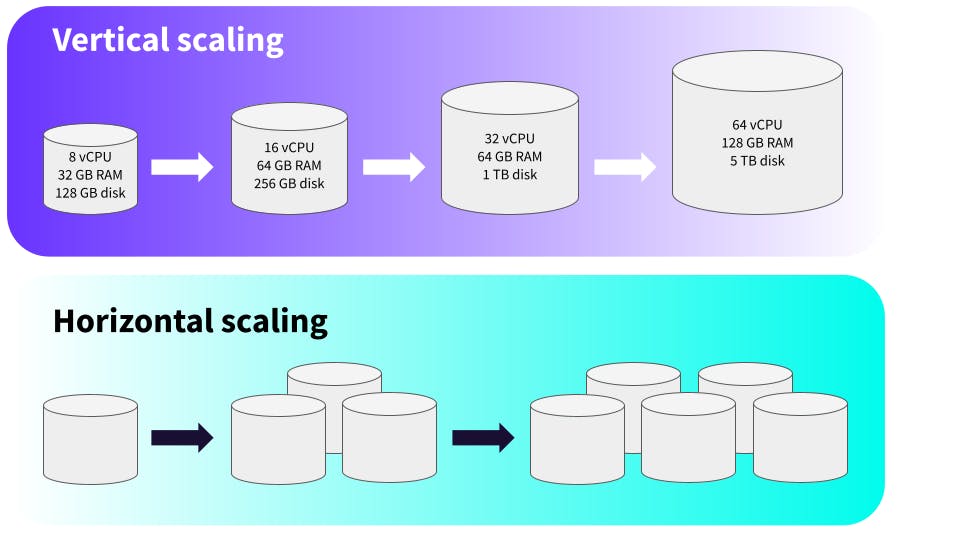
Understanding the difference between Horizontal Scaling and Vertical Scaling is essential when designing infrastructure that can grow efficiently. Vertical Scaling offers simplicity and ease of management, while Horizontal Scaling provides greater scalability, resilience, and flexibility. Choosing the right approach—or combining both—helps ensure that applications can meet future demand without compromising performance or reliability.
 2019 - 2023 © WELNIZ.LTD. All rights reserved.

 United Arab Emirates (Arabic)
 Worldwide (English)