In the past, the failure of a small component could cause an entire system to become unavailable. Today, organizations aim to build resilient systems that can continue operating even when some components fail.
This design approach is known as Graceful Degradation.
Graceful Degradation is a design strategy that allows an application to continue providing its core functionality even when certain non-critical components become unavailable.
Instead of experiencing a complete outage, the system temporarily reduces or disables specific features while keeping essential services operational.
Consider an e-commerce website:
However:
In this scenario, the website remains functional despite partial service failures.
Users can continue using essential features instead of encountering a complete system outage.
Critical services remain available, minimizing revenue loss and operational disruption.
Partial failures have a smaller impact on overall system functionality.
Applications become more capable of handling unexpected component failures.
Graceful Degradation is widely implemented in:
Determine which features must remain available under all circumstances.
Reduce tight dependencies between services so that one failure does not cascade throughout the system.
Serve previously stored data when backend services are temporarily unavailable.
Provide alternative responses or simplified functionality when a component fails.
Prevent repeated requests to failing services and allow the system to recover more efficiently.
Focuses on preventing outages by ensuring redundancy and fault tolerance.
Focuses on minimizing the impact of failures when they occur.
In other words, High Availability aims to keep systems running, while Graceful Degradation ensures users can still access essential functionality during partial failures.
Applications must be carefully designed to handle partial failures.
Fallback mechanisms and degraded modes must be regularly tested.
Teams must clearly define which services are critical and which can be temporarily reduced or disabled.
No. It does not prevent failures from occurring, but it significantly reduces their impact on users and business operations.
Yes. It is considered one of the key design principles for Microservices architectures, where individual service failures should not bring down the entire application.
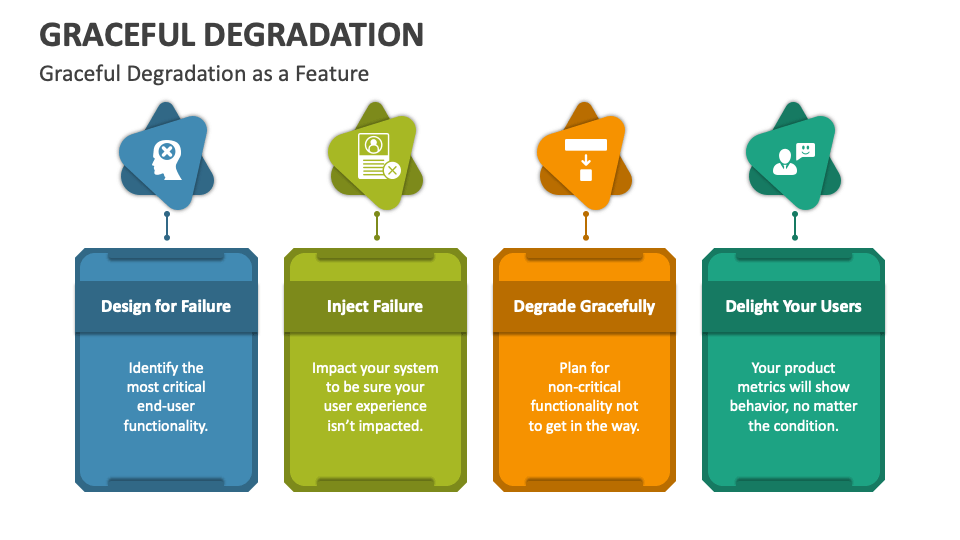
Graceful Degradation enables modern applications to continue delivering essential services even when certain components fail. By prioritizing core functionality, implementing fallback mechanisms, and reducing dependency-related failures, organizations can improve user experience, increase system resilience, and build more reliable applications.
 2019 - 2023 © WELNIZ.LTD. All rights reserved.

 United Arab Emirates (Arabic)
 Worldwide (English)