As modern applications continue to grow in scale and complexity, traditional architectures often struggle to keep up with increasing user demand and rapid response requirements. To address these challenges, many organizations have adopted Event-Driven Architecture (EDA) to build systems that are more scalable, flexible, and efficient.
Event-Driven Architecture (EDA) is a software design pattern where system components communicate through events rather than direct service-to-service calls.
An event can represent actions such as:
When a specific action occurs:
This allows services to react to events without needing direct knowledge of one another.
Consider an e-commerce platform.
When a customer completes a purchase:
All of these actions happen independently through events, without direct coupling between services.
New services can be added easily without modifying existing components.
Services operate independently, making the system more maintainable.
Multiple services can process events simultaneously, enabling parallel execution.
Applications become easier to update, extend, and evolve over time.
Tracking events across multiple services can become complex.
Failed events require careful management and recovery strategies.
EDA introduces additional architectural complexity compared to traditional systems.
No. Smaller applications may not benefit enough to justify the added complexity. EDA is most valuable in large-scale, distributed, or highly scalable systems.
They are related but not the same concept. Microservices define how applications are structured, while Event-Driven Architecture defines how components communicate. Many Microservices-based systems use EDA to achieve loose coupling and better scalability.
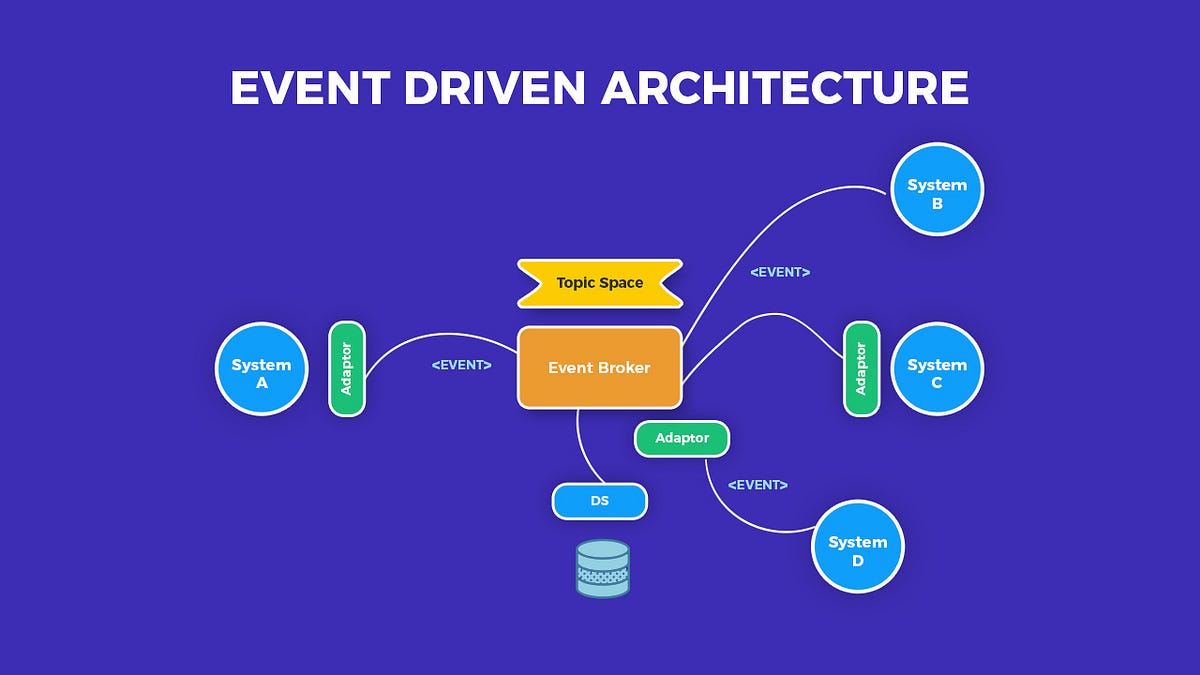
Event-Driven Architecture enables organizations to build highly scalable, resilient, and flexible systems. By allowing services to communicate through events rather than direct dependencies, EDA has become a popular architectural choice for modern cloud-native and distributed applications.
 2019 - 2023 © WELNIZ.LTD. All rights reserved.

 United Arab Emirates (Arabic)
 Worldwide (English)