Database Sharding: The Secret Behind Scaling Massive Databases???
HomepageArticlesDatabase Sharding: The Secret Behind Scaling M...
Database Sharding: The Secret Behind Scaling Massive Databases???
Introduction
As the number of users and the volume of data continue to grow, traditional databases can eventually reach their performance limits. This is where Database Sharding comes into play as one of the most important techniques for horizontal scaling.
What is Database Sharding?
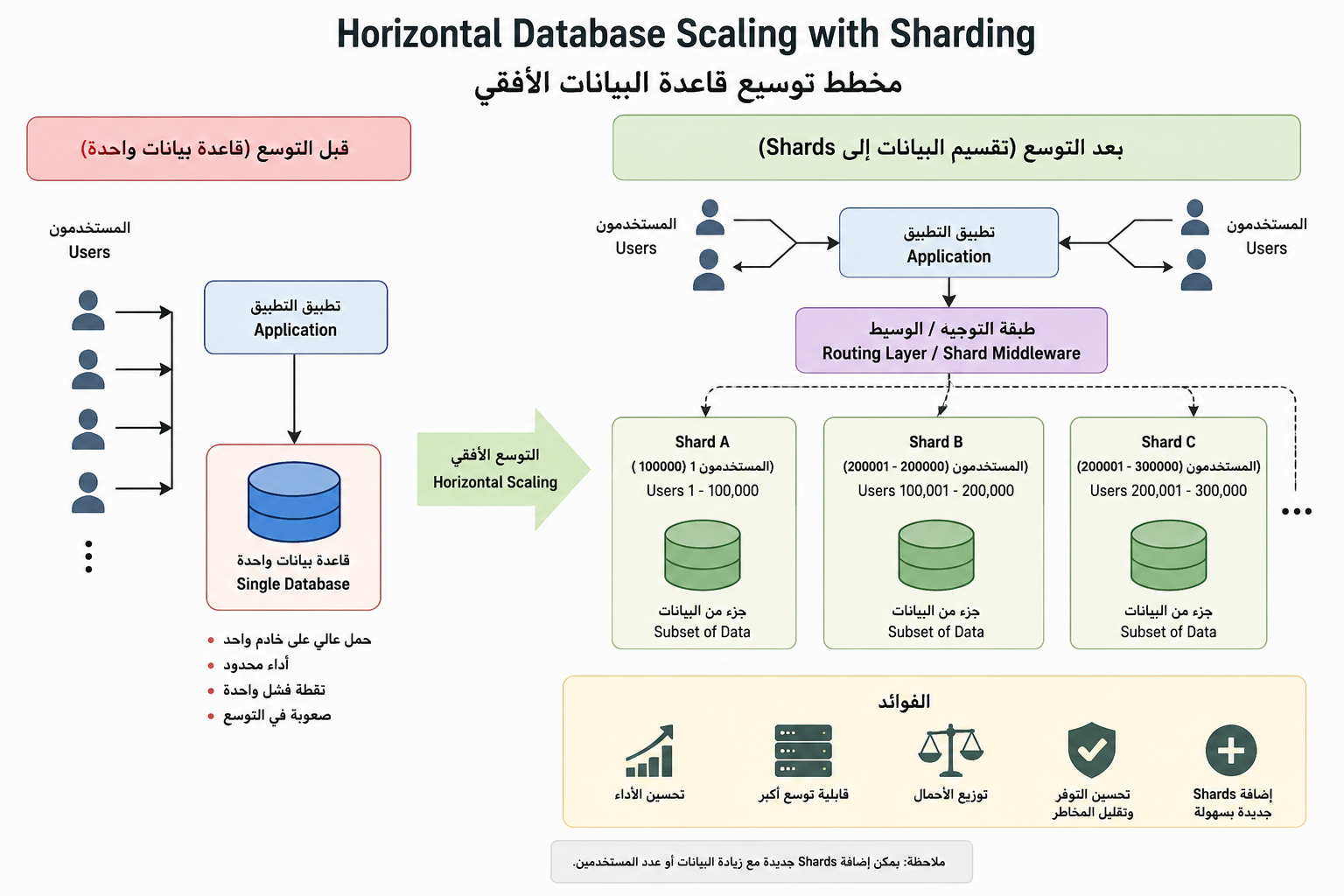
Database Sharding is the process of splitting a large database into multiple smaller parts called shards.
Each shard contains a subset of the data and is hosted on a separate database server.
Why Do Companies Need Sharding?
As the following increase:
Number of users
Volume of data
Number of transactions and queries
A single database server may struggle to handle all requests efficiently.
How Does Sharding Work?
Instead of storing all data in one database, the data is distributed across multiple shards.
For example:
Users 1–100,000 → Shard A
Users 100,001–200,000 → Shard B
Users 200,001–300,000 → Shard C
This distribution spreads the workload across multiple servers and improves scalability.
Benefits of Database Sharding
Improved Performance
Reduces the load on individual database servers.
Greater Scalability
New shards can be added as the system grows.
Load Distribution
Increases the system’s ability to process large numbers of requests simultaneously.
Better Availability
Failures in one shard affect only a portion of the data rather than the entire database.
Types of Sharding
Range-Based Sharding
Data is divided according to predefined ranges, such as user IDs or dates.
Hash-Based Sharding
A hash function determines which shard stores a specific record.
Geographic Sharding
Data is partitioned based on geographic regions or user locations.
Challenges of Sharding
Management Complexity
Operating multiple database instances is more complex than managing a single database.
Cross-Shard Queries
Some queries may require data from multiple shards, increasing complexity and latency.
Rebalancing Data
Adding new shards often requires redistributing existing data across the cluster.
Popular Systems That Support Sharding
MongoDB
Cassandra
Vitess
CockroachDB
FAQ
Is Sharding better than upgrading server resources?
Not always. Vertical scaling (adding more resources to a server) may be sufficient initially. However, sharding becomes essential when dealing with very large datasets and high traffic volumes.
Is Sharding suitable for small projects?
Usually not. Small applications often do not need the added complexity unless rapid growth is expected.
Conclusion
Database Sharding is one of the most powerful scaling techniques in modern data architectures. By distributing data across multiple servers, organizations can achieve higher performance, better scalability, improved availability, and more efficient management of massive datasets.
 2019 - 2023 © WELNIZ.LTD. All rights reserved.

 United Arab Emirates (Arabic)
 Worldwide (English)