Chaos Engineering: Why Do Companies Intentionally Test System Failures???
HomepageArticlesChaos Engineering: Why Do Companies Intentiona...
Chaos Engineering: Why Do Companies Intentionally Test System Failures???
Introduction
It may sound strange that companies intentionally create failures inside their systems, but this is exactly what happens in Chaos Engineering to improve the stability and reliability of modern applications.
What is Chaos Engineering?
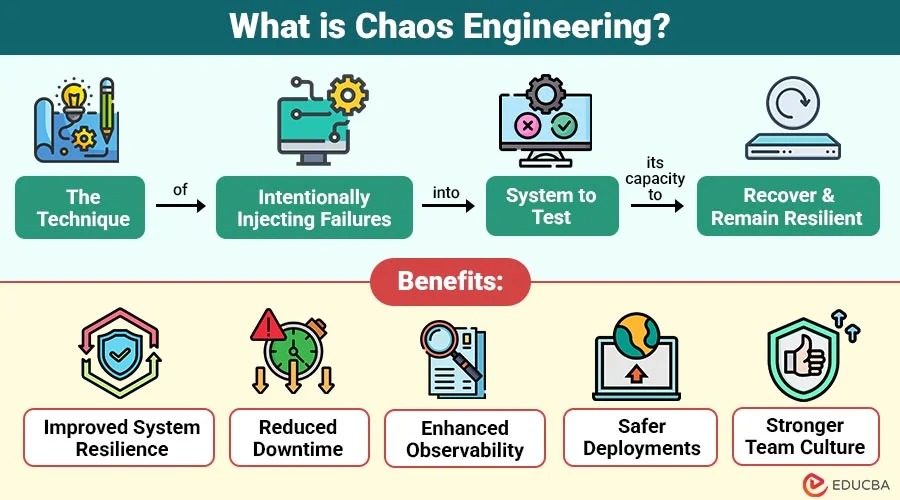
Chaos Engineering is a testing approach that evaluates how well systems can handle failures by intentionally creating controlled problems within the production or testing environment.
Why Is It Used?
The goal is to understand:
How the system reacts to failures
Whether hidden weaknesses exist
How resilient services are during outages
Examples of Chaos Engineering Tests
Suddenly shutting down a server
Disconnecting communication between services
Increasing system load and traffic
Temporarily disabling the database
Most Popular Chaos Engineering Tool
Chaos Monkey A tool developed by Netflix to test how systems handle unexpected failures.
Benefits of Chaos Engineering
Improved Stability
Problems are discovered before they happen in real-world scenarios.
Increased Reliability
Systems become more resilient and fault-tolerant.
Reduced Downtime
Weak points can be identified and fixed early.
When Do You Need Chaos Engineering?
Chaos Engineering is especially valuable for:
Cloud-based systems
Large-scale applications
Microservices architectures
High-availability platforms
Challenges
Requires advanced technical expertise
Can cause issues if implemented incorrectly
Needs strong monitoring and observability tools
FAQ
Is it suitable for small projects?
It is mostly used in large and complex systems.
Can it cause real outages?
Yes, if tests are not carefully controlled and monitored.
Conclusion
Chaos Engineering helps companies build stronger and more reliable systems by testing failures before they happen in real production environments.
 2019 - 2023 © WELNIZ.LTD. All rights reserved.

 United Arab Emirates (Arabic)
 Worldwide (English)